

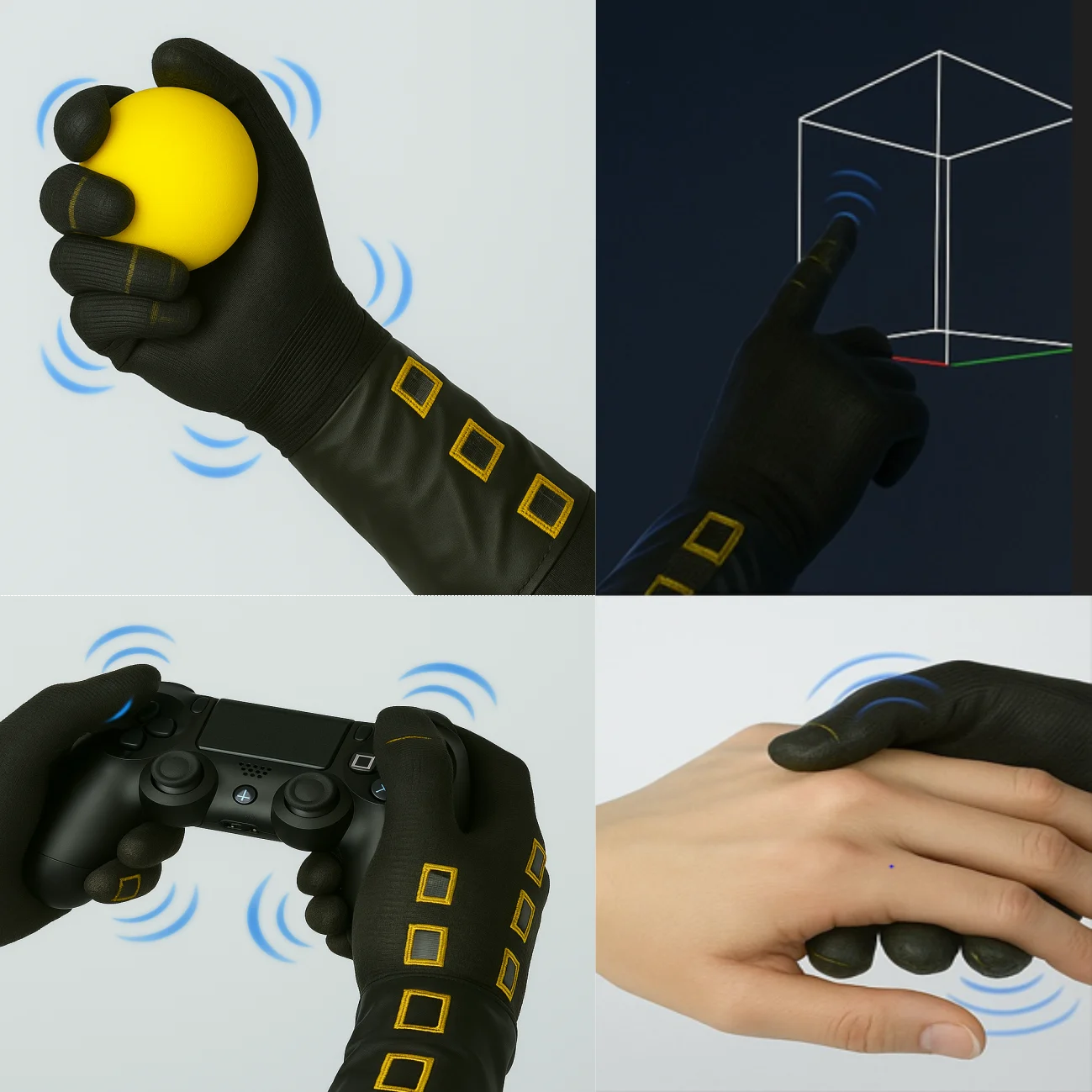
Can a glove integrated with liquid dielectric actuators change the way we interact with virtual worlds? A new collaborative study explores exactly that—building a crucial bridge between soft robotics and human perception to make virtual touch feel real.
The paper, titled “Influence of design parameters on the physical and perceptual performance of soft liquid dielectric actuators”, was published by researchers Gangadhar Mamillapalli, Robert Rosenkranz, Robert Kirchner, Ivan Zozulia, Ercan Altinsoy, and Yitian Shao. The team representing the Cluster of Excellence CeTI and TU Dresden investigates the precise fine-tuning of Liquid Dielectric Actuators (LDAs) for next-generation haptic wearables.
The Challenge: Making Virtual Objects Feel Real
LDAs act as the “muscles” of modern haptic gloves. Because they are soft, flexible, and use liquid dielectrics to generate movement, they allow for natural, unrestricted hand motion. However, creating a convincing tactile sensation is incredibly complex: to make a virtual object feel truly “real,” the physical engineering of the actuator must perfectly align with how the human brain and skin perceive touch.
Research Highlights: Tuning the Haptic Experience
To close the loop between robotic hardware and human sensory perception, the research team analyzed how specific design adjustments alter our physical experience:
-
Design Influence: The team systematically analyzed how different physical parameters—such as the actuator’s geometry and material composition—influence the intensity and quality of the feedback.
-
Physical to Perceptual Mapping: Instead of focusing purely on mechanical output (like vibration or force), the study maps these physical metrics directly to actual human tactile experiences and perception thresholds.
-
Seamless Wearable Integration: The findings demonstrate how these soft actuators can be seamlessly integrated into wearable gloves, offering realistic sensations without sacrificing user comfort.
The CeTI Impact
Whether it is a surgeon training in virtual reality, an operator controlling a remote robot with high precision, or an immersive gaming experience—better design parameters mean more realistic feedback. By defining how to optimize these soft actuators, this research brings us a significant step closer to a highly intuitive, life like Tactile Internet.
The full study is available open-access. Dive into the detailed physical and perceptual findings here.
Authors: Gangadhar Mamillapalli, Robert Rosenkranz, Robert Kirchner, Ivan Zozulia, Ercan Altinsoy, and Yitian Shao
This research is a collaborative work within the Cluster of Excellence CeTI (Centre for Tactile Internet with Human-in-the-Loop) at TU Dresden.