
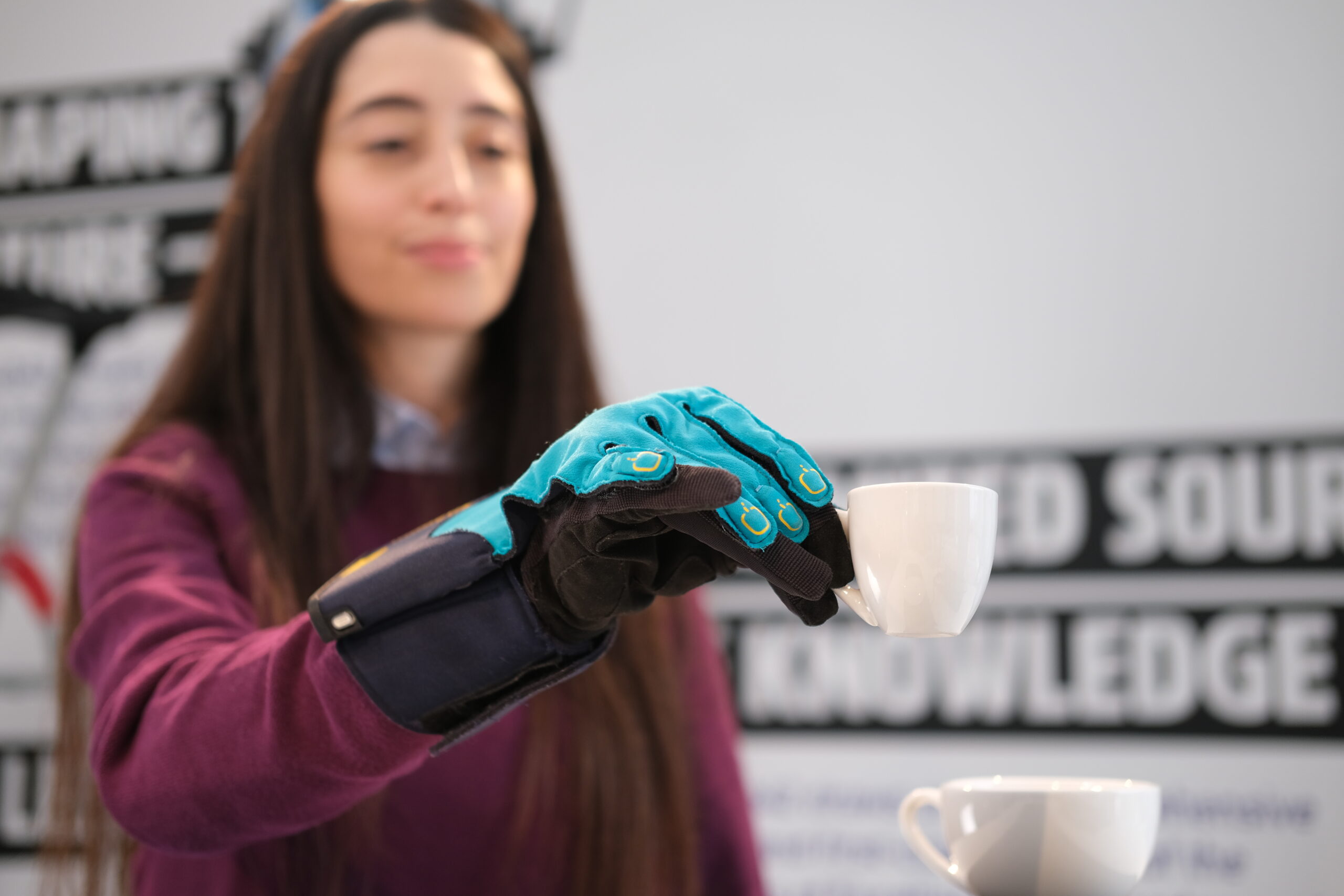
Real-time interactions in the Tactile Internet require synchronization between virtual and real-world actions. Latency, caused by data processing and transmission over long distances, is a key obstacle. The Negative Latency demonstrator showcases the prediction of human intentions for object manipulation using smart gloves equipped with IMU sensors. Objects to be grasped by a user are anticipated up to several hundred milliseconds in advance and displayed to the user, as well as the achieved negative latency in each trial. The anticipation allows for more immersive and responsive experiences, bridging the gap between physical actions and their virtual representations.

Share This Story, Choose Your Platform!

You might also like...

  • March 26, 2026

    conference + RIG + robotics

    German Robotics Conference 2026 in Cologne

    From Labs to National Strategy: CeTI’s Impact at the German Robotics Conference ...

  • March 17, 2026

    interview + research

    Enabling Data-Driven Excellence within CeTI: An Interview with Lize van der Linden

    At CeTI, interdisciplinarity is not just some priority — it's a core part of ou ...

  • February 27, 2026

    highlight

    New Definitive Work on the Tactile Internet: CeTI Launches Comprehensive Volume with Elsevier

    How will we interact with robots in the future? How does the Tactile Internet r ...

  • February 3, 2026

    collaboration + visit

    Research Insights: CeTI PhD Researcher as Visiting Student at Northeastern University

    From October to December of last year, Mingyu Ma, a PhD researcher at CeTI, had ...