

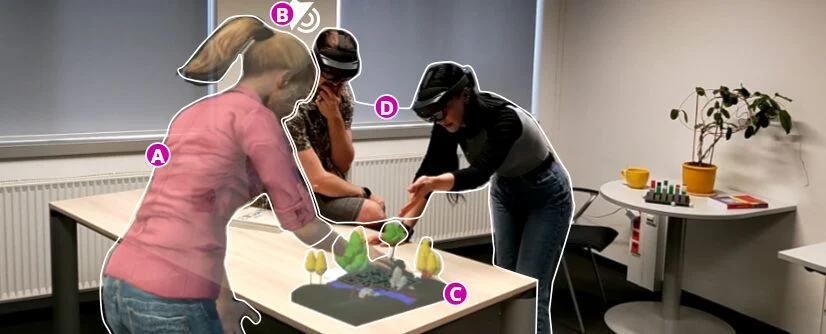
Developing environments where physical and virtual users can seamlessly interact is incredibly complex. At this year’s ACM CHI Conference on Human Factors in Computing Systems (CHI 2026) in Barcelona, researchers presented a foundational framework to bring clarity and structure to this emerging field.
The paper, titled “Mixed Presence in Mixed Reality: Charting the Challenges and Opportunities”, was co-authored by Katja Krug, Wolfgang Büschel, Marc Satkowski, Stefan Gumhold, and Raimund Dachselt. The team representing the Interactive Media Lab Dresden (Technische Universität Dresden) and the Cluster of Excellence CeTI tackled the systemic challenges of combining local and remote multi-user environments.
The Problem: Fragmented Solutions in a Complex Space
Developing Mixed Presence (MP) systems involves merging the intricacies of both co-located and distributed Mixed Reality. While the literature offers promising individual designs, the research landscape has remained highly fragmented. Developers and researchers often face the same re-occurring hurdles without a systematic overview or standardized guidance, leading to “one-off” solutions.
Research Highlights: Navigating the Challenges
To move beyond isolated solutions and establish a common ground, the research team implemented a multi-stage approach:
-
Comprehensive Review: The authors conducted a detailed review of current mixed-presence and multi-user remote MR systems to identify the status quo of the technology.
-
Systematic Categorization: The team organized and mapped prevalent development challenges, emerging trends, common use cases, and research methodologies.
-
Expert Ideation Workshop: Building on these findings, they hosted an expert workshop to map out promising future research directions and collaboratively address open questions.
The Result: A GPS for the MR Community
The outcome of this work is a comprehensive, structured resource that serves as a “GPS” for developers and researchers. By providing a clear navigation tool, the paper helps the Human-Computer Interaction (HCI) community bypass common design pitfalls and make highly informed decisions for the next generation of multi-user MR studies. This systematic progress brings us yet another step closer to the seamless, shared digital workspaces of the Tactile Internet.
The full conference paper from CHI 2026 is available open-access. Explore the findings, taxonomy, and future research directions hier.
Authors: Katja Krug, Wolfgang Büschel, Marc Satkowski, Stefan Gumhold, and Raimund Dachselt
This work is a collaboration between the Interactive Media Lab Dresden and the Cluster of Excellence CeTI (Centre for Tactile Internet with Human-in-the-Loop) at TU Dresden.