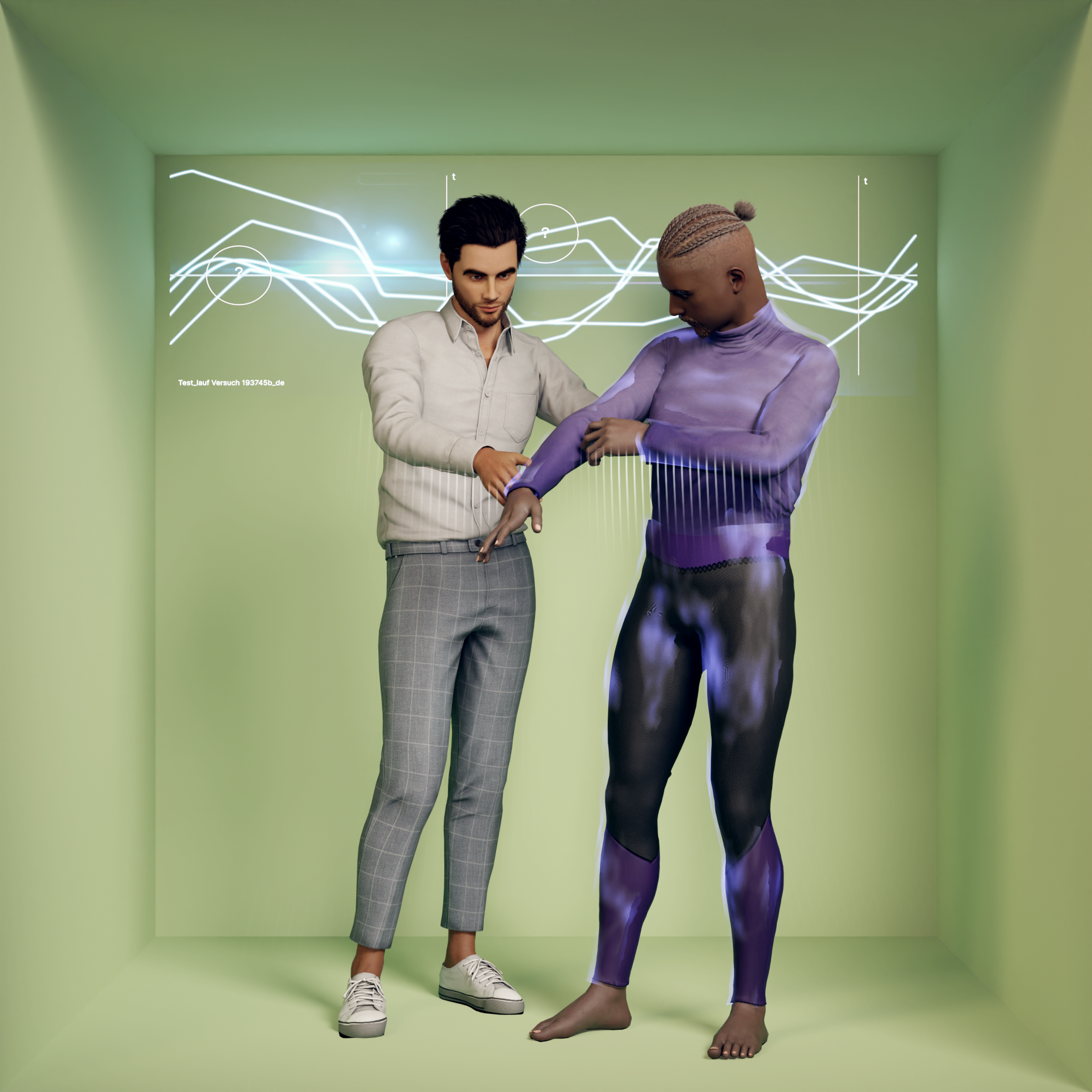

Taktiles Internet
Demokratisierung von Fähigkeiten – unser Forschungsschwerpunkt
The general imperative of the Centre for Tactile Internet with Human-in-the-Loop (CeTI) is to build communication platforms supported by novel digital technologies and AI as well as basic research on lifespan development of human sensory perception and action to enable skill exchanges between humans and machines collaborating in real and virtual spaces. CeTI has made significant progress in its first phase with plans for an ambitious second phase.
CeTI continues world-class interdisciplinary research, nurtures young talents, exerts multifaceted societal impacts, and promotes industry partnerships leading to economic growth.

Unsere Mission
The aim of CeTI is to develop innovative solutions for major global challenges, including pandemics, ageing societies, skill shortages, climate change, and geopolitical issues. We will explore use cases such as immersive remote collaboration, sensory augmentation for elderly care, AI-driven workforce support, and reduced travel through advanced telepresence.

CeTI ist ein interdisziplinärer Raum, in dem große Ideen die Energie, die Kreativität und das Know-how finden, um in inspirierende taktile Lösungen für das digitale Zeitalter umgesetzt zu werden.
Merle Fairhurst | TU Dresden
Unsere Forschungsziele
CeTI aims to achieve several breakthroughs beyond its first phase: develop new human-machine interfaces to integrate multiple senses and allow the prediction of human behaviour for novel skill learning; augment the capabilities of the Tactile Internet by incorporating the senses of smell and advanced touch, e.g. social affective touch, to address new use cases; broaden the scope of one-to-one human-robot interactions and investigate complex multi-human to multi-robot collaborations; build our own AI-enabled open-source communication platform for fixed and mobile communication networks to allow for fast prototyping of groundbreaking new paradigms to overcome the fundamental barriers known for current systems; and overcome key constraints of current computing systems, escaping the evolutionary trap of linear developments.

Das Konzept der virtuellen Forschungsräume
CeTI2 ist in vier Ebenen gegliedert: Grundlagen (F), Methoden (M), Komponenten (C) und Anwendungsfälle (U). Jede Ebene verfügt über fünf virtuelle Forschungsräume (VRRs), in denen Experten zusammenarbeiten. Auf den unteren Ebenen liegt der Schwerpunkt auf der Grundlagenforschung, während auf den höheren Ebenen die interdisziplinäre Teamarbeit in Bereichen wie Psychologie, Medizin und Ingenieurwesen im Vordergrund steht. Diese Struktur baut auf CeTI1 auf und wurde erweitert, um neue Forschungsherausforderungen effizient anzugehen.