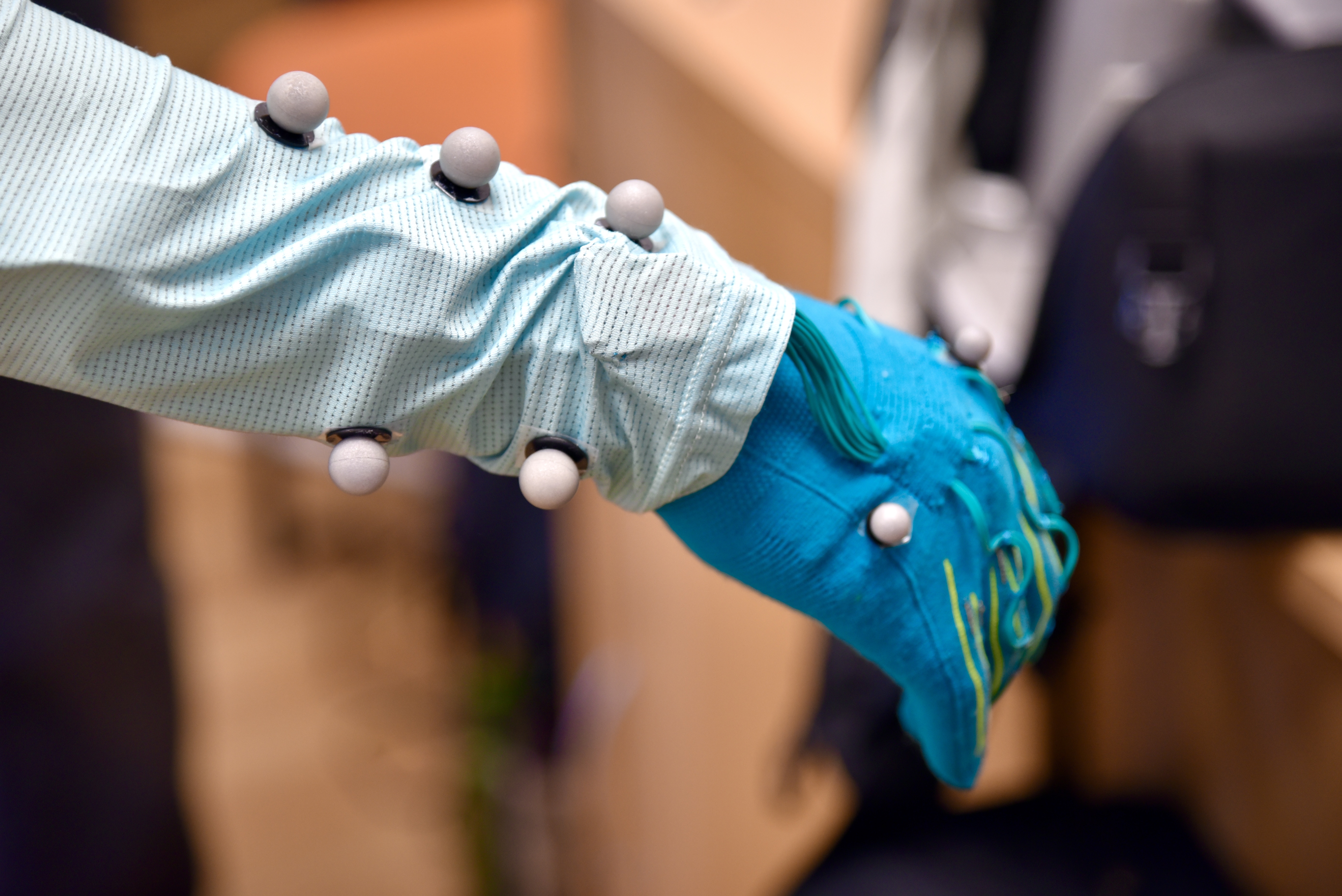

Every human has to develop a primal self-understanding as an independent bodily agent. Thus, newborns may initially have no association between what their eyes see and what their hands do. Only gradually do they develop an individual “body model” that allows them to recognize these hands as their “own” and, for example, to use them to reach for specific objects. Although neuroscience, psychology, and philosophy largely agree that the so-called body model is ultimately created by the brain, the exact mechanisms of this creative process are still unknown.
With the new Freigeist project “Re-Learning Body Models in the Human Brain”, the psychologist Dr. Jakub Limanowski (currently junior research group leader at the Cluster of Excellence CeTI – Centre for Tactile Internet with Human-in-the-Loop) aims to reveal these mechanisms: He believes that human-machine interactions – the control of an alternative ‘body’ in virtual or robotic environments – involve an active learning process that is very similar to the development of body models in newborns.
To illuminate these mechanisms, Dr. Limanowski and his Freigeist team at the Faculty of Psychology aim to develop a new account of body models in the form of a mathematical model that links the cognitive-computational mechanisms of perception, decision-making, and action – and their implementation in the brain. By combining innovative virtual reality experiments with measurements and direct manipulation of brain activity, the research group will shed light on three core mechanisms within this model: How does one actively learn to identify with a new (virtual) body; and how does one test and re-evaluate one’s own body model? What happens when one switches back and forth between physical and virtual bodies? How permanently does one’s body model change in such scenarios, and what are the consequences for bodily self-perception?
“By uncovering how people actively transform their body models, this project will provide the mechanistic understanding of the novel challenges we face as (re)embodied selves in human-machine interactions today,” explains Dr. Limanowski.
About the ‘Freigeist’ Fellowship
The Volkswagen Foundation’s ‘Freigeist’ Fellowships are aimed at unusual and courageous young researchers from all disciplines in the first four years after their doctorate. Each year, the Foundation selects up to fifteen “free spirits” who can receive up to 2.2 million euros over a maximum period of eight years. They offer young creative minds maximum freedom for their extraordinary research while providing a clear time perspective.
With a final round of approvals in 2021, the Volkswagen Foundation will end the early-career researchers program, which began in 2014 – in order to launch with new funding ideas following the realignment of its funding strategy. The next and final deadline for ‘Freigeist’ project submissions is 1 April 2021.